T-Dongle-S3
Board
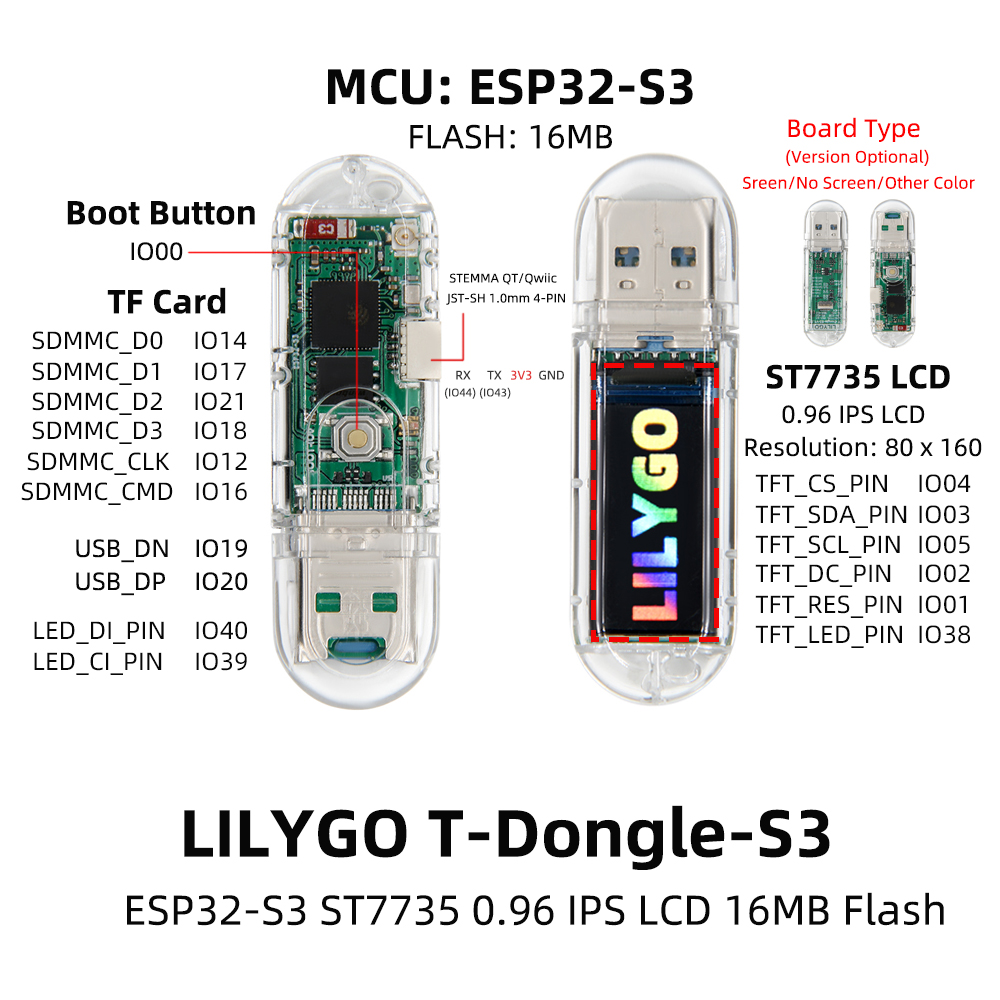
Specifications
Radiosinherited from ESP32-S3
- Wi-Fi
- Wi-Fi 4 · 2.4 GHz
- Bluetooth LE
- BLE 5
- Bluetooth Classic
- no
- 802.15.4
- no
USB
- Native USB
- yes
Board
- Form factor
- t-dongle
Display & extras
- Display
- 0.96in 80x160 ST7735 IPS
Compact ESP32-S3 dongle-form board with a 0.96in ST7735 IPS display and 16 MB flash.
Firmware for this board
Known good
- LauncherKnown goodrelease .bin
Flash Launcher
Known good esp-atlas asserts this board↔firmware link at the shown trust tier — it does not guarantee your specific unit or the current firmware version. Flashing can erase keys/config and can brick the device. At your own risk.
Reported
- ESPHomeReportedweb flasher
Flash ESPHome
Reported esp-atlas asserts this board↔firmware link at the shown trust tier — it does not guarantee your specific unit or the current firmware version. Flashing can erase keys/config and can brick the device. At your own risk.
Unverified
- USB Army KnifeUnverified
Flash USB Army Knife
Unverified esp-atlas asserts this board↔firmware link at the shown trust tier — it does not guarantee your specific unit or the current firmware version. Flashing can erase keys/config and can brick the device. At your own risk.
Notes
- ESP32-S3 Xtensa LX7; 16 MB flash
- Wi-Fi 802.11 b/g/n, Bluetooth 5
- Available in LCD/no-LCD and internal/external-antenna variants
- LilyGO's official spec table for T-Dongle-S3 explicitly lists "No PSRAM"
- io.gpio_free=2 DERIVED, not quoted (SPEC-io-power.md §5.3). The vendor Pin Diagram table lists RGB DIN=GPIO40, RGB CLK=GPIO39, SDMMC D0-D3/CLK/CMD=GPIO14/17/21/18/12/16, Button=GPIO0, QWIIC TX=GPIO43, QWIIC RX=GPIO44 -- of these, only the QWIIC connector (TX/RX) is externally accessible; the RGB LED, SD slot, and button rows are internal-only. So the board's exposed-pad set is {43,44} (2 pads). Subtracting esp32-s3's soc.reserved_pins that are exposed -- neither 43 nor 44 is in strapping {0,3,45,46} or usb_flash_tied {19,20,35,36,37} -- gives 2 - 0 = 2. Math not vendor-stated; verify before treating as exact.
Verify my board
Reads the connected chip over USB and checks it against what esp-atlas cites for T-Dongle-S3 — over Web Serial, no backend, nothing leaves your browser.
In-browser verify needs Web Serial: Chrome or Edge on a desktop. Safari, Firefox and phones cannot do it.
Serial monitor
Not connected.