WiFi LoRa 32 (V4)
BoardAlso known as: HTIT-WB32LAF
Specifications
Radiosinherited from ESP32-S3
- Wi-Fi
- Wi-Fi 4 · 2.4 GHz
- Bluetooth LE
- BLE 5
- Bluetooth Classic
- no
- 802.15.4
- no
USB
- Native USB
- yes
- Connector
- usb-c
- Bridge chip
- none — SoC native USB
Board
- Form factor
- heltec
- Dimensions
- 51.7 × 25.4 × 10.7 mm
- Battery connector
- yes
- Charging
- yes
Display & extras
- Display
- 0.96in 128x64 OLED SSD1315
- Extras
- lora
ESP32-S3R2 (2 MB PSRAM) + 16 MB external flash + SX1262 LoRa board with a 0.96in OLED, native USB-C, lithium battery charging, a solar input and a GNSS connector. Form factor and pinout compatible with the WiFi LoRa 32 V3; Meshtastic, MeshCore and LoRaWAN compatible.
Firmware for this board
No firmware recipes yet — help add one.
Notes
- ESP32-S3R2 with external flash: the datasheet reads "Base on ESP32-S3R2 & SX-1262, supports Wi-Fi b/g/n, BLE, and LoRa communication." and "2MB PSRAM and 16MB external Flash"
- Distinct from the WiFi LoRa 32 V4-R8 sibling: the product page reads "The WiFi LoRa 32 now comes with the latest ESP32-S3R8 version. They use different firmware versions." The V4-R8 (ESP32-S3R8, 8 MB PSRAM) moves Vext_Ctrl, VGNSS_Ctrl and LED to other GPIOs and is a separate record; this one is the ESP32-S3R2 / 2 MB PSRAM board
- usb.bridge=native DERIVED: Heltec's V3-vs-V4 comparison lists the USB to Serial Chip as CP2102 on V3 and "Removed CP2102" on V4, and the V4 datasheet routes the ESP32-S3's own USB pins to the connector ("GPIO19,U1RTS,ADC2_CH8, USB_D-" and "GPIO20,U1CTS,ADC2_CH9, USB_D+"); usb_serial derived from usb.bridge (native) + soc usb.type serial-jtag
- power: the datasheet lists a "SH1.25-2P lithium battery interface" and a Charging mode (USB@5V, 500 mA typical) in its power consumption table; it also adds a solar input ("Added SH1.25-2P solar panel interface.") and a GNSS connector ("Added SH1.25-8Pin GNSS interface.") -- the GNSS receiver itself is not on the board
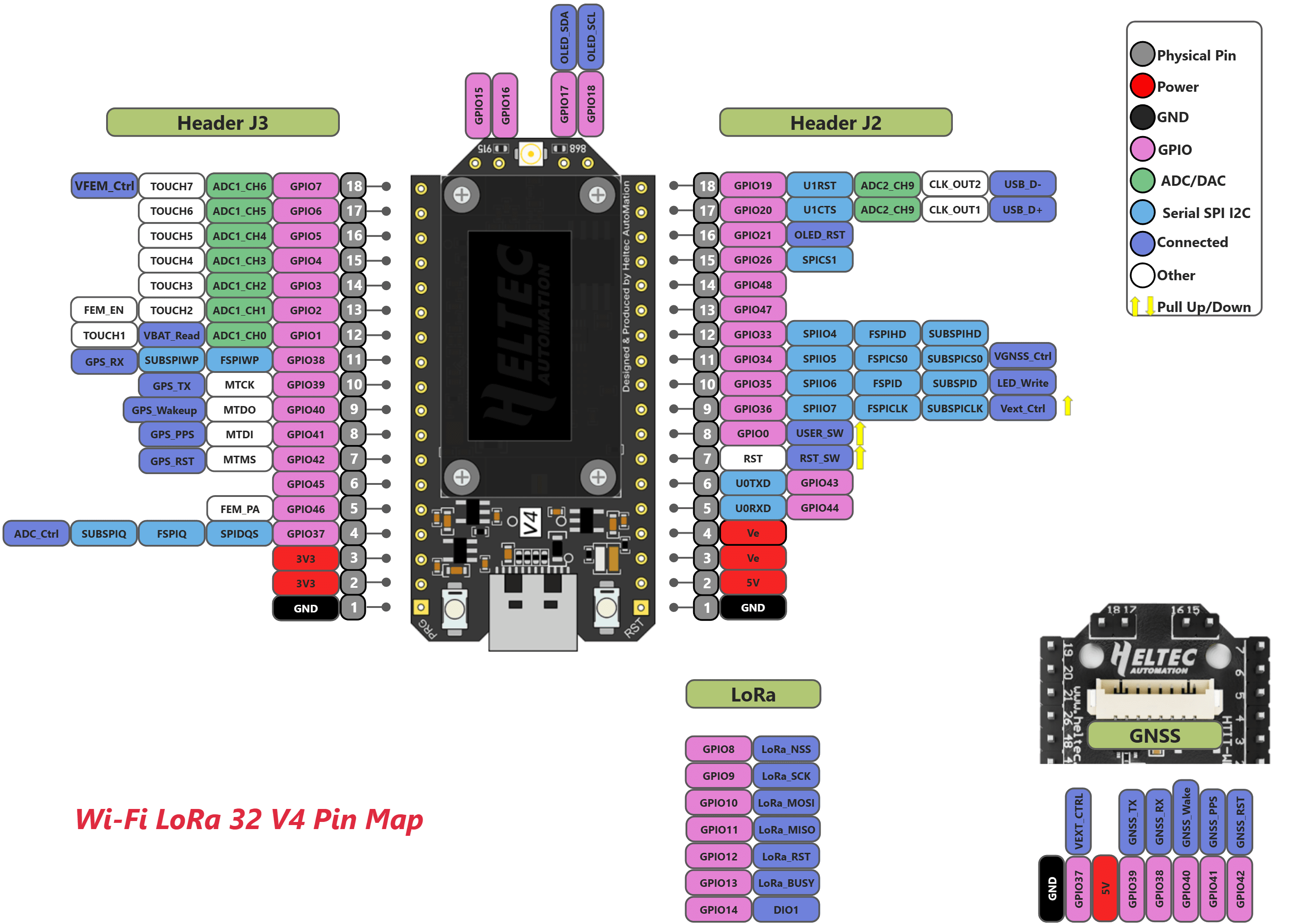
- io.gpio_exposed=32 DERIVED from the datasheet pin tables and Heltec's V4 pin map: Header J2 GPIO {44,43,0,36,35,34,33,47,48,26,21,20,19} (13), Header J3 GPIO {37,46,45,42,41,40,39,38,1,2,3,4,5,6,7} (15) and the four "Additional Pin" pads GPIO {18,17,16,15} on the two 2-pin headers ("2*18*2.54 Header Pins, 2*2*2.54 Header Pins") = 32. The SX1262 SPI/control lines (GPIO8-14) are wired onboard and never reach a header. io.gpio_free is omitted: several exposed pins double as onboard control lines (OLED RST/SDA/SCL, Vext_Ctrl, ADC_Ctrl, LED, GNSS, LoRa FEM) that differ between hardware revisions
- Two hardware revisions share this name: Heltec's guide says to select USE_GC1109_PA for V4.2 and USE_KCT8103L_PA for V4.3 in the Arduino LoRa FEM menu
- LoRa: the high-power version (HTIT-WB32LAF, 863-928 MHz) transmits up to 28 +/- 1 dBm per the datasheet; the product page also lists a low-power version (433-510 MHz)
- The product page offers the board with the OLED or with no display; display describes the default OLED version
Verify my board
Reads the connected chip over USB and checks it against what esp-atlas cites for WiFi LoRa 32 (V4) — over Web Serial, no backend, nothing leaves your browser.
In-browser verify needs Web Serial: Chrome or Edge on a desktop. Safari, Firefox and phones cannot do it.
Serial monitor
Not connected.