ESP32-PICO-KIT
BoardAlso known as: pico32
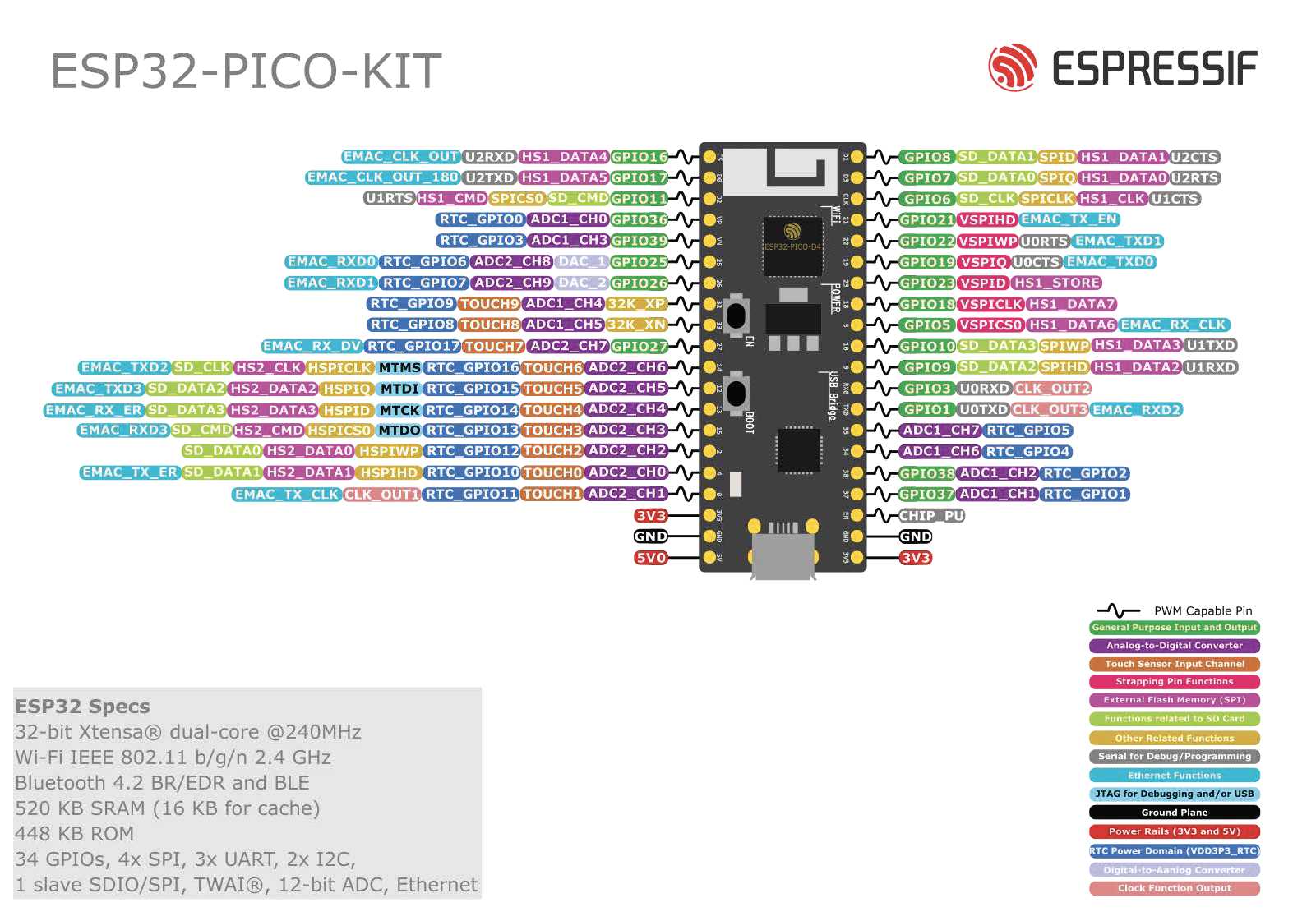
Specifications
Radiosinherited from ESP32
- Wi-Fi
- Wi-Fi 4 · 2.4 GHz
- Bluetooth LE
- BLE 4.2
- Bluetooth Classic
- yes
- 802.15.4
- no
USB
- Native USB
- no
- Connector
- micro-usb
Board
- Form factor
- devkit
- Dimensions
- 52 × 20.3 × 10 mm
Small ESP32-PICO-D4 SiP board (52 x 20.3 x 10 mm) with a single micro-USB UART-bridge port.
Firmware for this board
No firmware recipes yet — help add one.
Notes
- Micro-USB UART-bridge port; bridge chip is CP2102 on v4 (up to 1 Mbps) or CP2102N on v4.1 (up to 3 Mbps) — version-dependent, so usb.bridge left unset
- Built around the ESP32-PICO-D4 SiP (complete ESP32 system including 4 MB flash); no PSRAM
- Single red 5V Power-On LED
- io.gpio_free=19 DERIVED, not quoted (SPEC-io-power.md §5.3). Headers J2+J3 break out all 34 pads on the chip (quoted from the user guide pin tables: J2 = GPIO 1,3,5-10,18,19,21-23,34,35,37,38; J3 = GPIO 0,2,4,11-17,25-27,32,33,36,39). Subtracting esp32's soc.reserved_pins that are exposed -- strapping {0,2,5,12,15} (5), input_only {34,35,36,39} (4), and usb_flash_tied {6,7,8,9,10,11} (6) -- gives 34 - 5 - 4 - 6 = 19. Math not vendor-stated; verify before treating as exact.
Verify my board
Reads the connected chip over USB and checks it against what esp-atlas cites for ESP32-PICO-KIT — over Web Serial, no backend, nothing leaves your browser.
In-browser verify needs Web Serial: Chrome or Edge on a desktop. Safari, Firefox and phones cannot do it.
Serial monitor
Not connected.